


The Coney Island Cyclone in Cinerama
Waller used 5 Kodak Cine-Special II 16mm cameras to shoot footage from planes that were being attacked. This was shown on a dome-like screen, which 4 artillery men could watch simultaneously. The footage was analyzed frame by frame to plot the attacking aircrafts' positions. When the guns were "fired" a light beam struck one of the light sensitive cells mounted behind the screen. This was compared with the plotted aircraft positions, and if the shot was a hit, projection stopped at once. It was very efficient.
But getting all that stuff coordinated was so much of a pain that Waller later said it was child's play to go on to Cinerama from there.
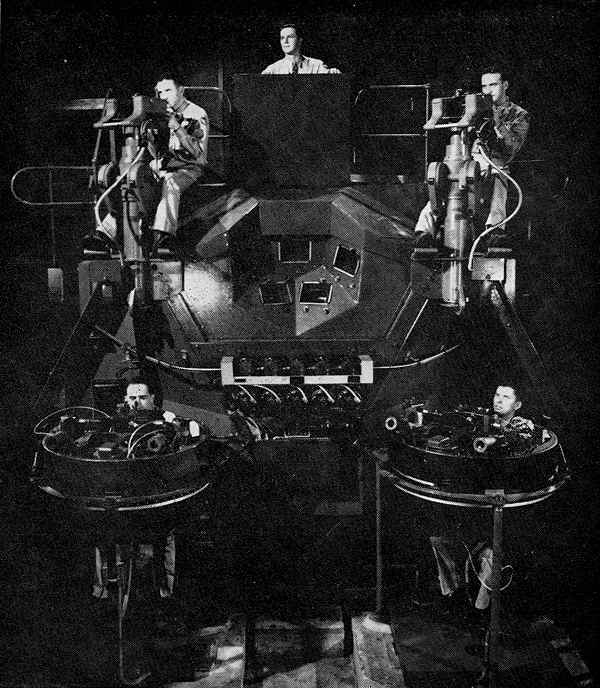
gunners and trainer in position
There have been projection systems like Circarama (all around you) which were very good too. In London there was one where the audience had to stand, and people actually fell down to the floor when the going got rough. Interestingly, this came from the USSR but worked with Philips 16mm projectors which used strobe lights instead of butterfly shutters. The screens were separated by narrow black bands, just as good as Cineramas fuzz.

Three 35mm cameras were used, each with an almost square image (not Academy-sized), resulting in a total projected image of 2.65:1. I can't even start to imagine the contraption they edited that footage on. The three strips were projected next to each other, with little saw-like gadgets moving in the aperture window to blur the distinctive separation lines. For some reason, these were called "gigolos". Your guess is as good as mine (they went up and down, that's for sure). This didn't really help; when you walked out of a Cinerama theater you saw that, during the screening, they had fixed strips of masking tape on the projection booth windows. The grapevine had it that the management of the Dutch Tuschinski theater chain treated the operators to a dinner when they'd had a hitchless performance.
Besides the three film projectors, there was a 35mm tape recorder running in sync, containing 7 sound-tracks and one switching track. The sound of Cinerama was marvelous. The later one-screen Ultra-Panavision "Cinerama" was not only visually inferior, but only had 6 tracks and ran at 2/3 the speed.
Because the screen was curved so deeply, it consisted of separate parallel vertical strips to prevent light reflections from one part of the screen to another.

One movie you can get is How the West Was Won.
You clearly notice the frame separation — until the camera starts moving
(which I can't show you).

It's also obvious we do not get to see left and right of the image entirely
actual aspect ratio is 2.6 to 1.

To get rid of those fuzzy lines, they always tried to put something on them.

They tended to keep the actors on one strip during every shot
but here Jimmy Stewart intrepidly makes the jump, miraculously re-materializing.

On television, this is the most you got to see.
That the movie is still popular in spite of all that attests to its quality.
In the present DVD-version, the lines have been removed digitally and horzons straighted out, giving rise to some really weird all-new artifacts.

original Cinerama screen
compare with the video-dvd version (up)
Mike Todd, one of the promotors of Cinerama, had the same idea as Hathaway. He exclaimed "It has to come out of one hole!" and together with American Optical developed Todd-AO. His first show Around the World in Eighty Days was such a hit that 70mm theaters came out like a rash. Now again available, in DVD/Letterbox format, complete with Saul Bass' titles
How The West Was Won

The sprawling story of three generations of 19th-century pioneers, and their odyssey from New England to the frontier, is a true western classic. The all-star cast includes John Wayne, Henry Fonda, Debbie Reynolds, James Stewart, Carroll Baker, Gregory Peck and Lee J. Cobb, and Spencer Tracy narrates. Co-directed by John Ford, Henry Hathaway and George Marshall. 1963 155 min. Widescreen; Soundtracks: English Dolby Digital stereo, French Dolby Digital stereo; Subtitles: English, French, Spanish; "making of" documentary.
A very interesting movie released in 3-strip Cinerama was George Pal's 1962 The Wonderful World of the Brothers Grimm. It used moving mattes joining over the 3 strips. You can only get it in VHS and probably not even letterboxed. (Sob — It was there on LaserDisc...)


Old Friend Revisited
In November 2011 we went over all the way to Seattle
for Cinerama Theater original 3-strip screenings of
This Is Cinerama
and
How the West Was Won
There still is nothing that can touch it—nothing.
Lots of old-timers, like me, there to undergo it again. Lots of curious youngsters as well.
One remark: The sound was much too loud, like in all cinemas these days.
That's Dolby® for you, folks!

more on
Screen Aspect Ratios
more on

then you may want to know

SEARCH this site or the Web

copyright notice
How the West Was Won copyright © Loew's Incorporated
all material on this site, except where noted
copyright © by , curaçao
reproduction in any form for any purpose is prohibited
without prior consent in writing
